 Ensembles
SamarkandUNESCO World Heritage
Registan
The central square of old Samarkand, framed on three sides by the Ulugh Beg, Sher-Dor and Tilla-Kari madrasas.
The Zarafshan valley around Samarkand: Timurid domes and tilework in the city, the Bukhari memorial to the north, and the bazaar town of Urgut in the foothills to the south.
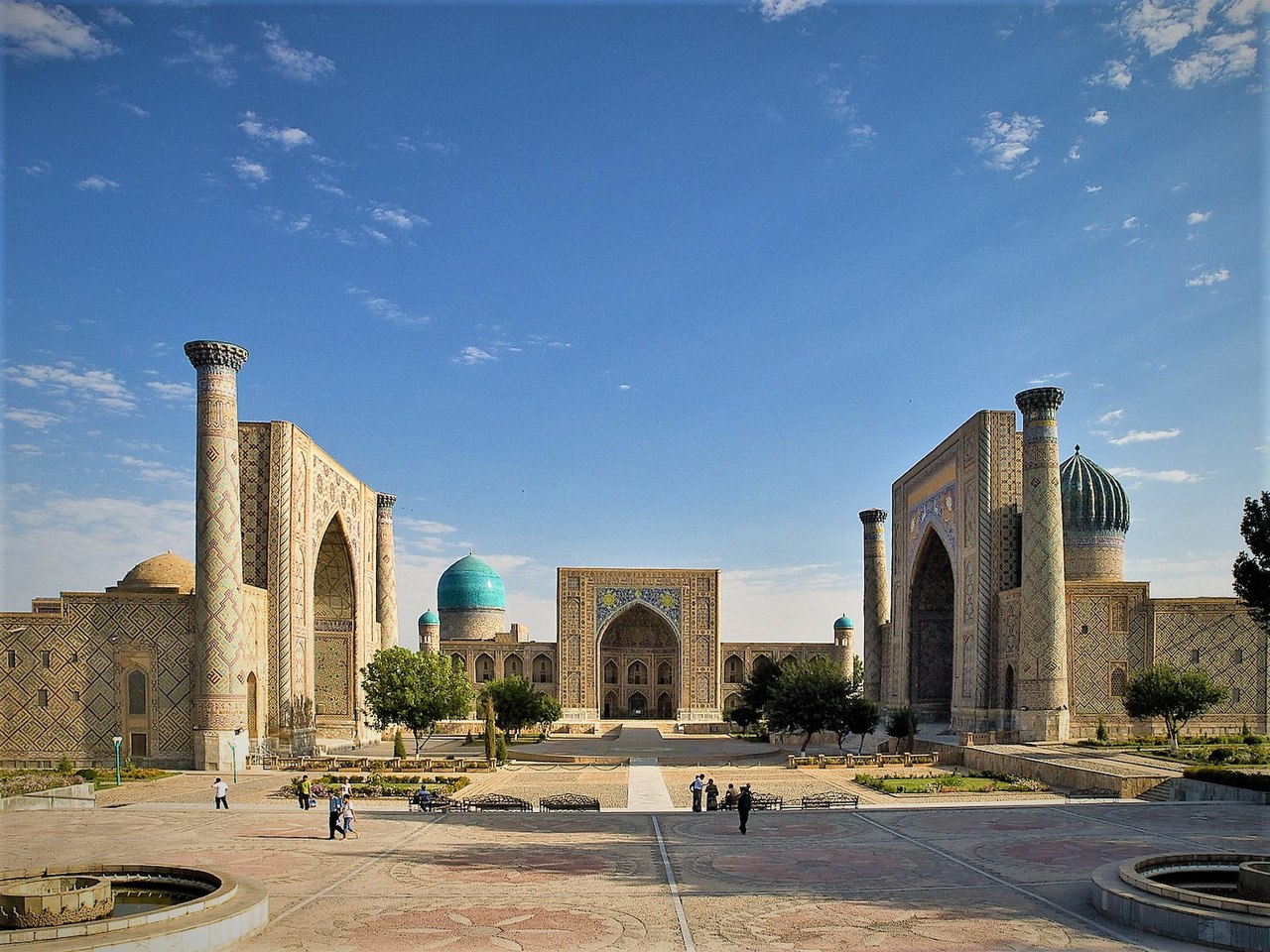
Photo 1 of 12
Most visitors come for the city of Samarkand, and it deserves the time: the Registan, Gur-e-Amir, Shah-i-Zinda and Bibi-Khanym sit within walking distance of each other, with the Siab Bazaar and the old mahalla lanes in between.
The region around the city is worth a day or two more. The Zarafshan river runs through flat, irrigated farmland, while the Zarafshan and Turkestan ridges rise to the south with walnut groves, springs and cooler air. Urgut, Konigil and the Imam al-Bukhari complex are all easy half-day trips.
Samarkand grew out of Afrasiyab, the walled hill on the northern edge of today's city, which was the capital of Sogdiana long before Alexander the Great reached it in 329 BC. Sogdian merchants carried goods and languages along the caravan routes between China, Iran and India.
The Mongols destroyed the old city in 1220, and the town was rebuilt to the south. Under Amir Timur, who made Samarkand his capital in the late 14th century, and his grandson Ulugh Beg, it became a centre of architecture, astronomy and scholarship. Most of the monuments you see today date from that Timurid era or from the Shaybanid and Ashtarkhanid rulers who followed.
In 1868 the city came under Russian rule, and a new European-style quarter with broad avenues was laid out west of the old town. That split between the Timurid core and the 19th-century streets is still easy to read when you walk around.
The fastest way from Tashkent is the Afrosiyob high-speed train, which takes a little over two hours; slower Sharq and regular passenger trains also run the route and continue to Bukhara. Book ahead in spring and autumn, as seats sell out.
Samarkand International Airport has direct flights from Tashkent and a growing list of international routes. By road, the M39 highway links Samarkand with Tashkent through Jizzakh, and shared taxis leave from the Tashkent side of the city for the four- to five-hour drive.
The main monuments are close together, and the pedestrian Tashkent Street links Registan, Bibi-Khanym, the Siab Bazaar and Shah-i-Zinda. Ride-hailing apps such as Yandex Go work well in the city and are the easiest way to reach the station, the airport or the observatory.
For Urgut, Konigil, the Bukhari complex or the mountains, hire a driver for half a day or a day. Marshrutka minibuses go to Urgut and the district towns, but they are slow and signs are in Uzbek.
April to early June and September to October are the most comfortable months, with mild days for walking between monuments. July and August are hot and dry; plan sightseeing for early morning and evening.
Winters are cold but usually short, and the tilework looks sharp under a clear winter sky with few crowds. Navruz on 21 March brings festivities and family outings across the region.
Samarkand bread is a point of local pride: dense, glossy rounds stamped with patterns, sold at the Siab Bazaar and in neighbourhood bakeries. Buy one warm and it will keep for days.
Samarkand plov is cooked in layers, with the rice laid over the meat and carrots and not stirred together, which sets it apart from the Tashkent style. Try it at lunchtime, when plov centres serve it fresh, along with shashlik, somsa from a tandoor and seasonal fruit from the bazaar.
The Meros workshop in Konigil has revived Samarkand silk paper, made from mulberry bark with water-driven mallets; you can watch the process and buy notebooks and sheets.
Urgut is known for suzani embroidery and its large Sunday market, where old and new textiles are sold. In the city, workshops around the Registan madrasas sell ceramics, carpets, embroidery and miniature painting; ask to see work in progress before you buy.
A combined ticket is not sold for all monuments, so expect to pay at each site; carry some cash in soʻm, as card terminals are not everywhere.
Shah-i-Zinda, the Daniel mausoleum and the Bukhari complex are active pilgrimage places: dress with shoulders and knees covered, women may want a scarf, and keep your voice low near the tombs. The Registan is lit in the evening, which is a good time to come back after a day of sightseeing.
EnsemblesSamarkandUNESCO World Heritage
The central square of old Samarkand, framed on three sides by the Ulugh Beg, Sher-Dor and Tilla-Kari madrasas.
 Mausoleums
SamarkandUNESCO World Heritage
The ribbed blue dome over the tomb of Amir Timur and members of his family, including his grandson Ulugh Beg.
 Ensembles
SamarkandUNESCO World Heritage
A narrow lane of mausoleums climbing the edge of Afrasiyab hill, with some of the finest glazed tilework of the Timurid era.
 Ensembles
SamarkandUNESCO World Heritage
The great Friday mosque that Timur built after his campaign in India, with a vast entrance portal and blue domes beside Siab Bazaar.
 Bazaars
SamarkandUNESCO World Heritage
Samarkand's main food market, next to Bibi-Khanym, known for its round stamped bread, dried fruit, nuts and spices.
 Archaeology
SamarkandUNESCO World Heritage
The remains of the fifteenth-century observatory where Ulugh Beg and his scholars compiled a star catalogue, with a small museum beside it.
No hosts here yet. Browse experiences across the country.
See all experiences